
-
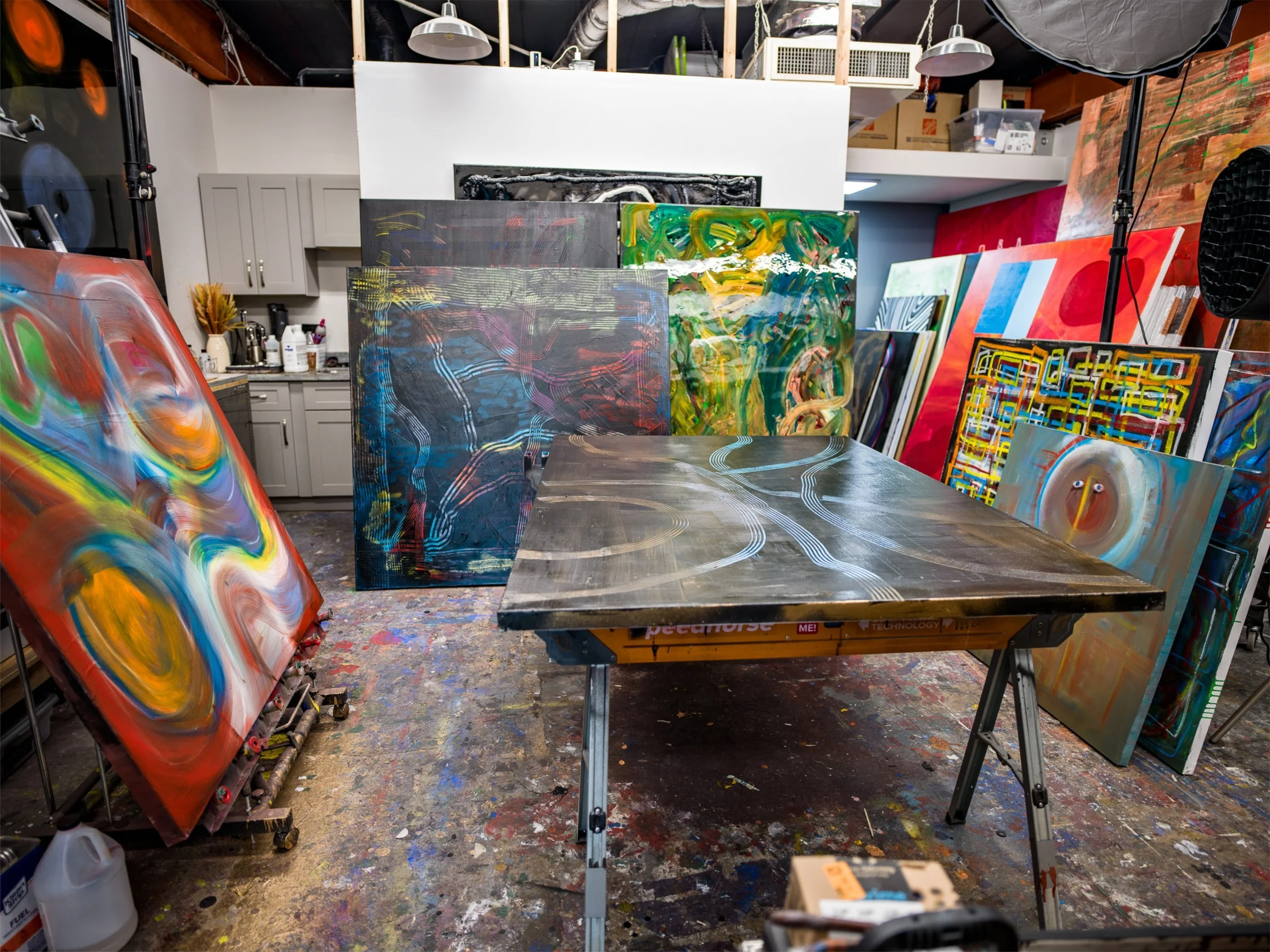
![An art studio filled with colorful, abstract paintings leaning against walls and a table. The floor is splattered with paint, and there is equipment and supplies scattered around.]()
Monet Goode
FOUNDER
-
![A man in a gray turtleneck observes colorful abstract artwork in a gallery with a black and white wood grain patterned wall.]()
Emmett Marsh
DESIGN DIRECTOR
-
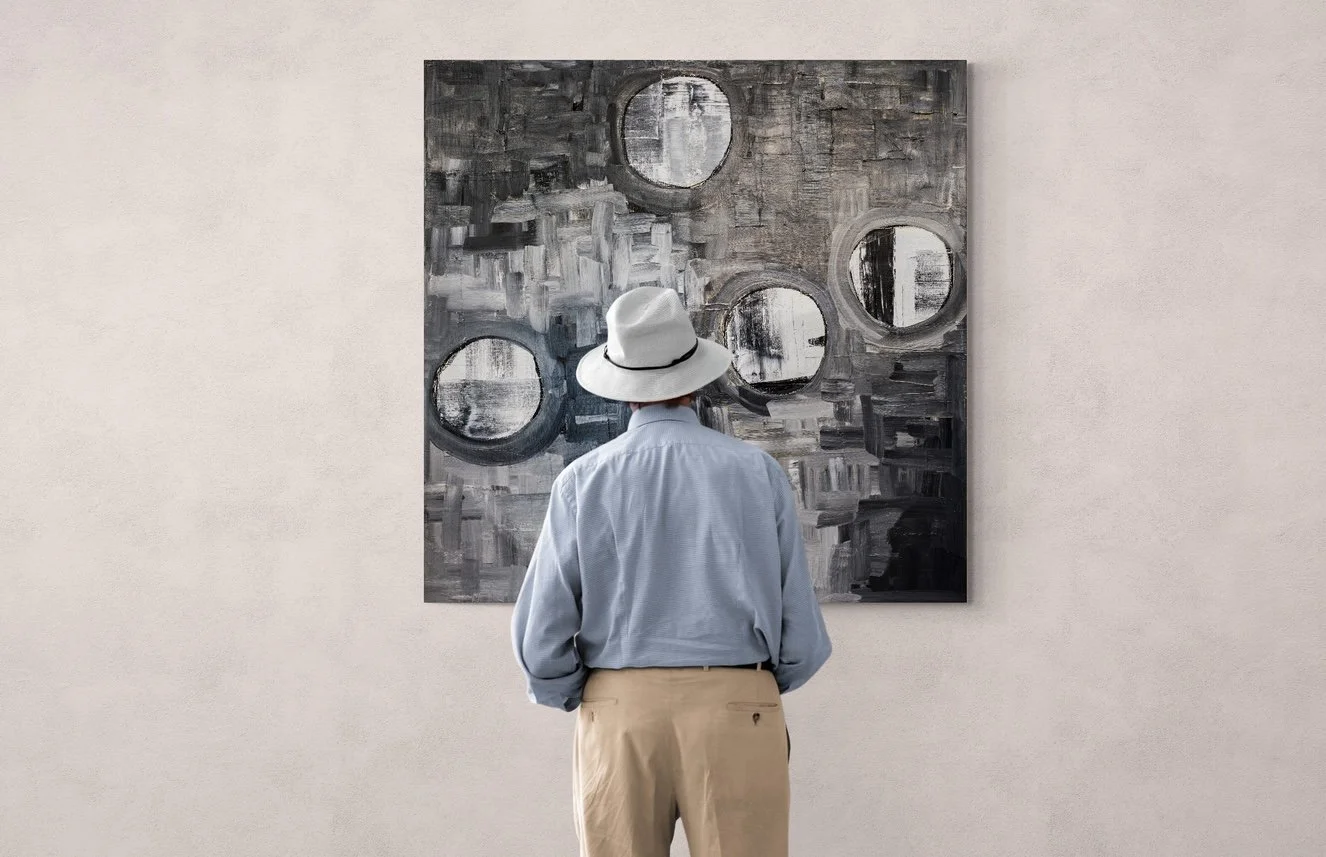
![A person in a light blue shirt, beige pants, and a white hat stands facing an abstract black-and-white painting with circular shapes, in an art gallery with plain white walls.]()
New List Item
Description goes here -
![A woman sitting on a wooden bench in an art gallery, looking to her left. Behind her are four large colorful abstract paintings on a white wall.]()
New List Item
Description goes here -
![Modern living room with two blue sofas and a large abstract painting on a concrete wall.]()
New List Item
Description goes here -
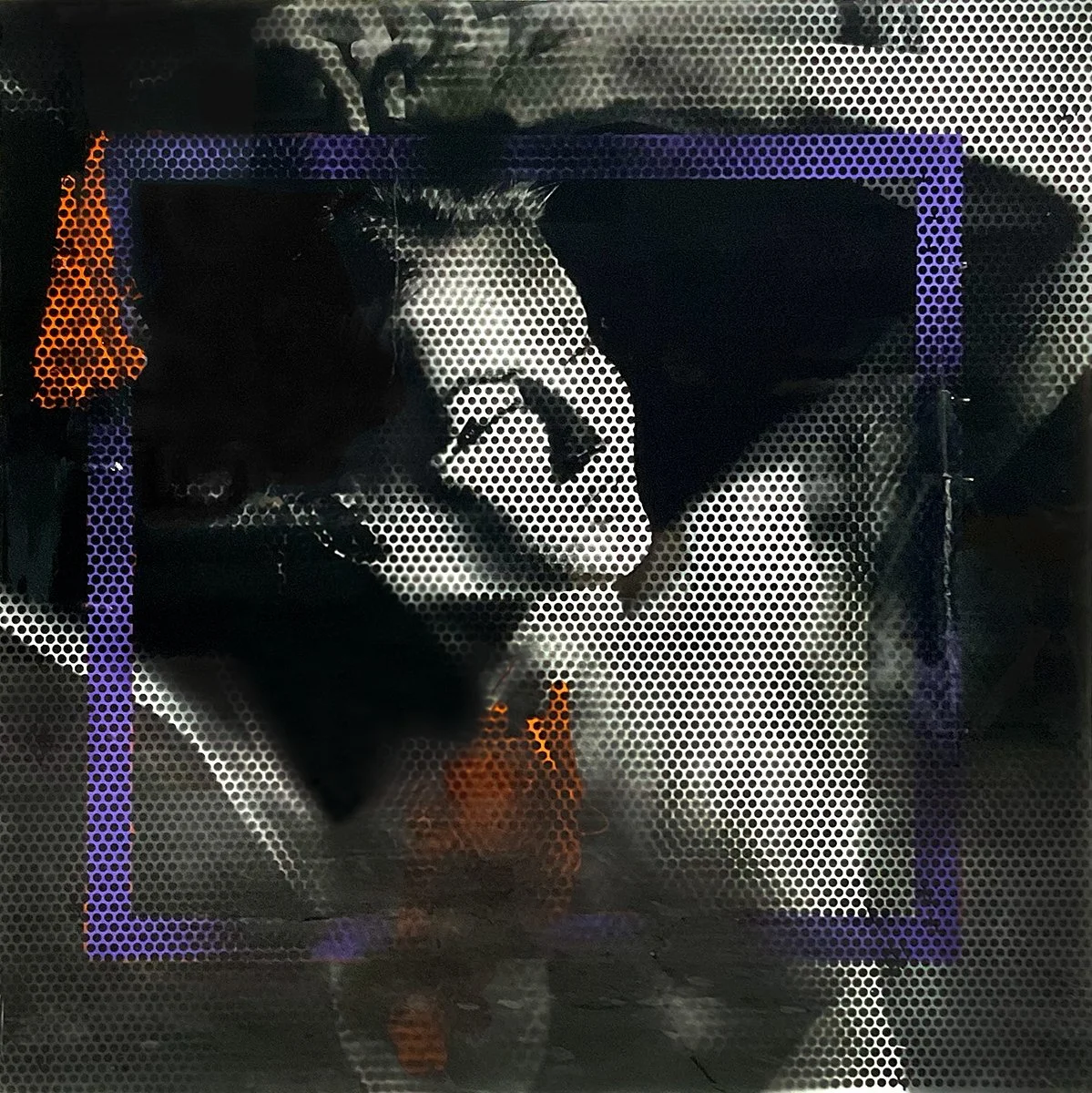
![A person dressed as a mime with white face paint and black clothing, behind a perforated surface with a dot pattern, possibly a microwave door, creating a distorted reflection.]()
New List Item
Description goes here -
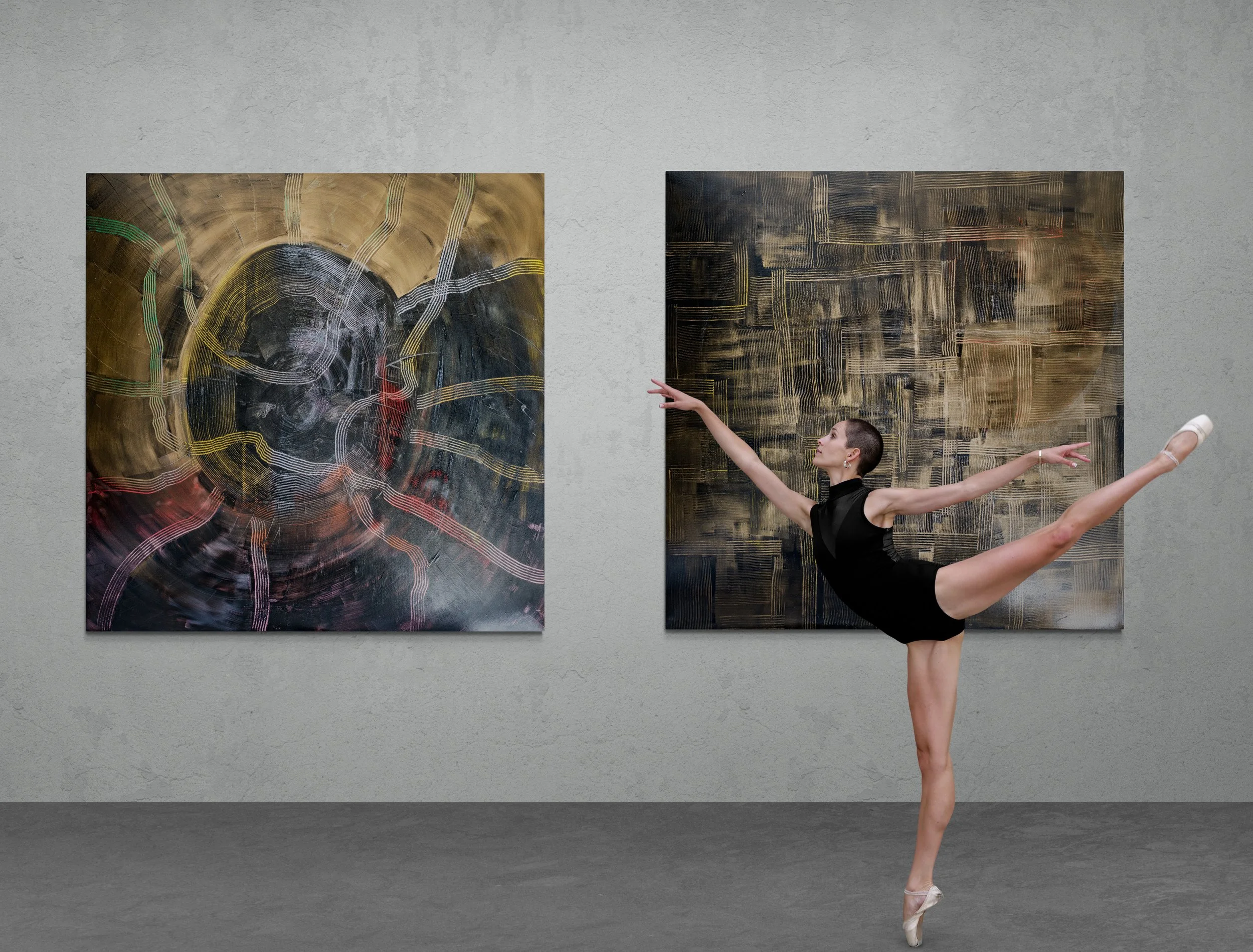
![A ballet dancer performing an arabesque in front of two abstract paintings in an art gallery.]()
New List Item
Description goes here



-
![An artist's studio filled with colorful abstract paintings, a wooden work table in the center, and art supplies on the floor and shelves, with overhead studio lights and an industrial ceiling.]()
Monet Goode
FOUNDER
-
![A man in a gray turtleneck observing two abstract paintings with bold colors and geometric shapes, hanging on a black and white swirling patterned wall.]()
Emmett Marsh
DESIGN DIRECTOR
-
![A person wearing a white hat, light blue shirt, and khaki pants viewing abstract black and white artwork with circular patterns on a gallery wall.]()
New List Item
Description goes here -
![A person sitting on a bench in an art gallery, looking at colorful abstract paintings on the wall.]()
New List Item
Description goes here -
![Modern living room with concrete wall, featuring a large abstract art piece with circular patterns and colorful lines, and two blue sofas on a dark wood floor.]()
New List Item
Description goes here -
![A black and white artwork of a person with short hair, possibly tattooed, seen through a surface with a dotted pattern, creating a magnified effect.]()
New List Item
Description goes here -
![A ballet dancer performs a balanced pose with one leg extended high and arms outstretched, standing in front of two abstract paintings in an art gallery.]()
New List Item
Description goes here
The Philosophy of Exploring Abstraction
Exploring Abstraction is not simply a presentation — it is an ongoing, universal inquiry, both artistic and experiential

What happens when we let go of representation?
What might we discover when the familiar falls away, and only form, color, and movement remain?
Exploring abstraction is more than an artistic category or historical movement — it is a living, universal inquiry into perception itself. Abstraction asks a radical question: What happens when we release the need to represent the world as it appears? What unfolds when the familiar falls away and only form, color, rhythm, and movement remain?
Throughout the history of art, abstraction has served as a pathway into the unseen. In works like Hilma af Klint’s Altarpiece No. 1 (1907), color and geometry become a spiritual architecture, revealing dimensions of experience that cannot be captured by representation alone. Abstraction is not merely a visual style; it is a way of sensing, a space where perception unfolds without the constraints of literal meaning.
In this expanded field of seeing, the artwork does not depict — it resonates. Like music without lyrics, abstraction speaks through tone, rhythm, vibration, and energy. A curve, a shift in hue, the density of a surface — each becomes an entry point into emotion, memory, intuition, or the quiet presence of the body itself.
Abstraction as Embodied Perception
When we begin to see through this lens of sensation rather than recognition, our relationship with art — and with perception — changes. We move from passive looking to active, embodied engagement. We no longer ask, “What is this?” but rather, “What does this feel like?” or “What does this awaken in me?”
Transformation occurs not as a dramatic epiphany, but as a subtle realization:
abstraction is not a departure from reality — it is a return to the raw source of experience.
The brushstroke, the hue, the vibration of a line — these do not point toward experience; they are experience. To explore abstraction is to encounter the material of consciousness itself. And in that encounter, something within us shifts. We enter deeper contact with perception, presence, and possibility.
The Sensory Ground of Abstract Art
At its core, abstract art is rooted in sensory experience.
A field of cobalt blue may move through us like a scent or a song.
The weight of a line may feel almost tactile — a pressure we register physically.
Vision becomes embodied, participatory.
The artwork is no longer something to look at; it is something to dwell with.
Philosophical Roots: Phenomenology and Presence
This approach draws from phenomenology — the study of direct experience — and echoes the ideas of thinkers like Heidegger, who believed art reveals the nature of being. Abstraction removes the anchor of recognition and invites us to slow down, to inhabit the space between forms, and to notice ourselves perceiving.
The painting exists.
We exist.
And in that quiet, shared presence, something profound can occur.
Emotional Resonance Without Narrative
Abstraction also speaks directly to the subconscious.
A surge of red may stir energy or unease; a muted gray may evoke stillness or loss.
This ambiguity is not a void — it is a freedom.
Without a fixed narrative, abstraction becomes a mirror of the inner world.
We are invited to feel without explanation, to encounter ourselves without the safety of meaning already decided.
Multiplicity and Meaning
Abstraction welcomes multiple interpretations.
What appears as a landscape to one viewer may read as pure movement to another.
What feels serene to one may feel charged to someone else.
This is not a limitation — it is abstraction’s greatest strength.
Meaning is not given; it is discovered.
The viewer becomes co-creator.
A Changing Relationship Over Time
Abstraction also evolves.
A painting that once felt closed may later feel open; a form once overlooked may suddenly vibrate with clarity. This evolution does not happen on the canvas but within us.
Abstraction reveals itself slowly — always shifting, always becoming.
An Invitation Into the Unknown
Ultimately, Exploring Abstraction invites us to dwell in the unknown — to trust our senses, to welcome ambiguity, to step into the richness of what escapes definition. In a world saturated with certainty and surface, abstraction opens a rare space: a space of breath, reflection, wonder, and transformation.
It reminds us that understanding does not always require language.
Sometimes what we need is color, rhythm, silence — a space where feeling leads and form follows.
Exploring abstraction is not an argument, but an invitation:
to see with more than the eyes,
to feel without rushing to name,
and to discover what lies just beyond the visible.